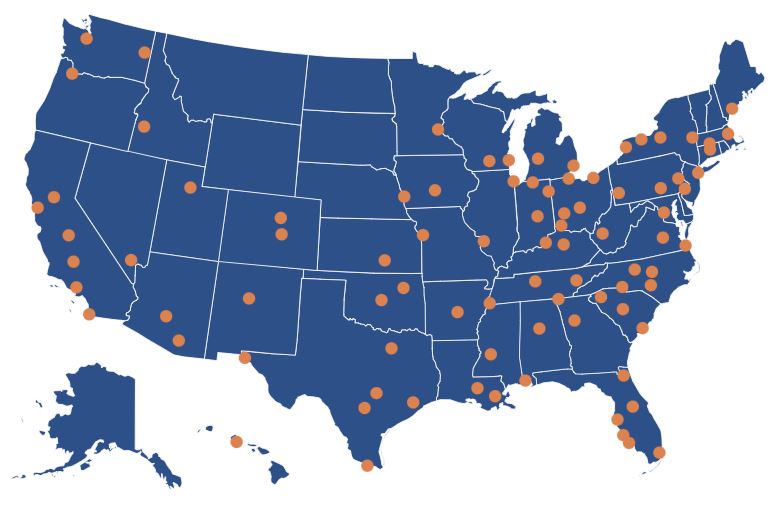
Some markets get CW and others get CW Plus. The primetime shows are the same. The difference is who programs the rest of the day, and it explains why CW Plus usually turns up on a subchannel.
You scan your channels, look for The CW, and find it listed as something slightly different: CW Plus. The word "plus" suggests an upgrade, a premium tier, or a second channel carrying extra shows. It is none of those. Here is what The CW Plus actually is, and whether you are missing anything by having it.
The short version: The CW Plus is The CW's feed for smaller markets. You get the same network programming in primetime. The difference is everything around it: on a regular CW station the local broadcaster fills the rest of the day, while on The CW Plus the network itself programs the full schedule. It usually arrives on a subchannel of another station rather than on a station of its own.
A regular CW affiliate
In larger markets, The CW works the way any network does. A local station signs on as the affiliate, carries the network's schedule, and fills the rest of the day with syndicated programming it buys itself: talk shows, reruns, court shows, whatever its programmers think will do well locally. It sells its own advertising, and in some markets it produces its own newscast.
That station might be a full channel of its own, or it might live on a subchannel of a bigger station in town. Either way, the local broadcaster is making the programming decisions outside of network hours.
What The CW Plus does differently
Plenty of markets are too small to support a station like that: one with its own programming staff buying syndicated shows, its own ad sales, and enough viewers to justify the whole operation while competing with the ABC, CBS, NBC, and FOX stations in the same town. So The CW runs a second feed, The CW Plus, aimed at markets roughly ranked 100 and smaller on Nielsen's list of the 210 US television markets. It carries the same network shows, and then the network takes care of everything else too.
Instead of a local programmer buying syndicated shows, The CW Plus arrives as a complete 24-hour schedule. The network acquires the talk shows, the off-network reruns, the movies, and the paid programming, and hands the local operator a finished channel. For a small station, that is the entire appeal: a full lineup with none of the cost or work of assembling one.
The service is not new. It started as The WB 100+ Station Group in 1998, and became The CW Plus when The WB and UPN merged into The CW in 2006. Today it runs on roughly 123 outlets across 44 states and territories.
How it reaches you
Most often, The CW Plus rides on a digital subchannel of an existing station in your area, showing up as something like 8.3 or 12.2 in your channel list. In some markets it is a station's main channel, and in others it is carried only on cable and satellite, with no over-the-air signal at all.
That last case is the one worth checking before you go hunting for it with an antenna. If your market's CW Plus is cable-only, no amount of antenna adjustment will find it.
What actually differs on screen
Primetime is the same either way. The differences show up in the other twenty hours:
- Daytime and late night. A regular affiliate runs what its own programmers chose. The CW Plus runs the national schedule, so viewers in Bangor and Bakersfield see the same shows at the same time.
- Local news. A full affiliate may produce its own. The CW Plus sets aside windows where a local operator can insert a newscast, including a weekday morning slot, but many operators do not use them.
- Commercials. Local ad breaks still belong to the local operator in both cases, which is why you still see ads for the car dealer down the road.
Does it matter for your antenna?
Not for reception. Both come in the same way, and a CW Plus channel is no harder to receive than any other.
The one practical difference is picture. Because The CW Plus so often sits on a subchannel rather than a station's main channel, it is frequently broadcast in standard definition while the host station's main channel is in HD. That is a bandwidth decision made by the station carrying it, not a fault in your setup. We explain how stations split their signal, and why some channels are sharper than others, in Why Aren't All My Antenna Channels in Full HD?.
Which one do you have?
The easiest way to tell is to look at your own channel list, where the network name is spelled out. Both are common depending on where you live, and a channel labeled CW Plus sitting on a subchannel of a local station is the classic small-market setup.
Look up your city to see which stations near you carry The CW or The CW Plus, what channel number it lands on, and how strong the signal should be at your address.