Cut the Cord.
Drop the Subscriptions.
Enjoy Free Local TV.
Drop the Subscriptions.
Enjoy Free Local TV.

Pluto TV streams hundreds of live channels of movies and shows, free and with no subscription. It makes a great supplement to your local antenna lineup: your stations bring the news and live sports, Pluto fills in around them.
Disclosure: This article contains affiliate links. If you buy through them, TV Stations Near Me may earn a small commission — at no extra cost to you.
If you've cut the cord, your setup is probably a few pieces stitched together: an antenna for local channels and live sports, maybe a subscription or two for movies and the specific shows you follow. There's a third piece worth knowing about that costs nothing at all: free, ad-supported streaming. The biggest name in it is Pluto TV.
The appeal is that there's nothing to sign up for and nothing to cancel: no subscription, no trial, no card on file. Install it on a smart TV, a streaming stick, a phone or a browser, and you get hundreds of channels that are already running. It will offer to let you create a free account, but that's optional. The login exists to remember your favorites, your watch history and where you left off across devices, not to unlock anything. Skip it and you get the same channels.
 Look for this icon. Pluto TV is preinstalled on many smart TVs and is a free download on Roku, Fire TV, Apple TV, Google TV, PlayStation and Xbox, plus phones, tablets and any web browser. Search your device's app store for “Pluto TV” and this yellow circle is what you're after.
That fills a gap subscriptions don't. An on-demand service asks you to scroll a wall of thumbnails and choose something every single time you sit down. Sometimes you just want what television has always been: you turn it on, something is already playing, and you either stay put or flip through channels to see what else is on. Kids are often the same way, only more so: they don't want to browse anything, they want another episode of the show they already like, and a channel that runs nothing but that show does the job better than a menu ever will. Pluto TV is good at that, and it's good at the kind of older, niche programming the big subscription services don't bother carrying: old sitcoms, classic game shows, cartoons your kids have never seen, entire channels devoted to a single series.
It's worth understanding what Pluto TV actually is, though, because it isn't a replacement for the free TV you already get over the air, and because it overlaps with it in ways almost nobody points out.
Pluto TV is a FAST service: Free Ad-Supported Streaming Television. Instead of a menu of things to click, it's built around a channel grid that behaves like cable. Every channel sticks to a theme and runs around the clock, playing whether anyone is watching or not. You tune in, you land in the middle of something, and it keeps going. Ads pay for all of it.
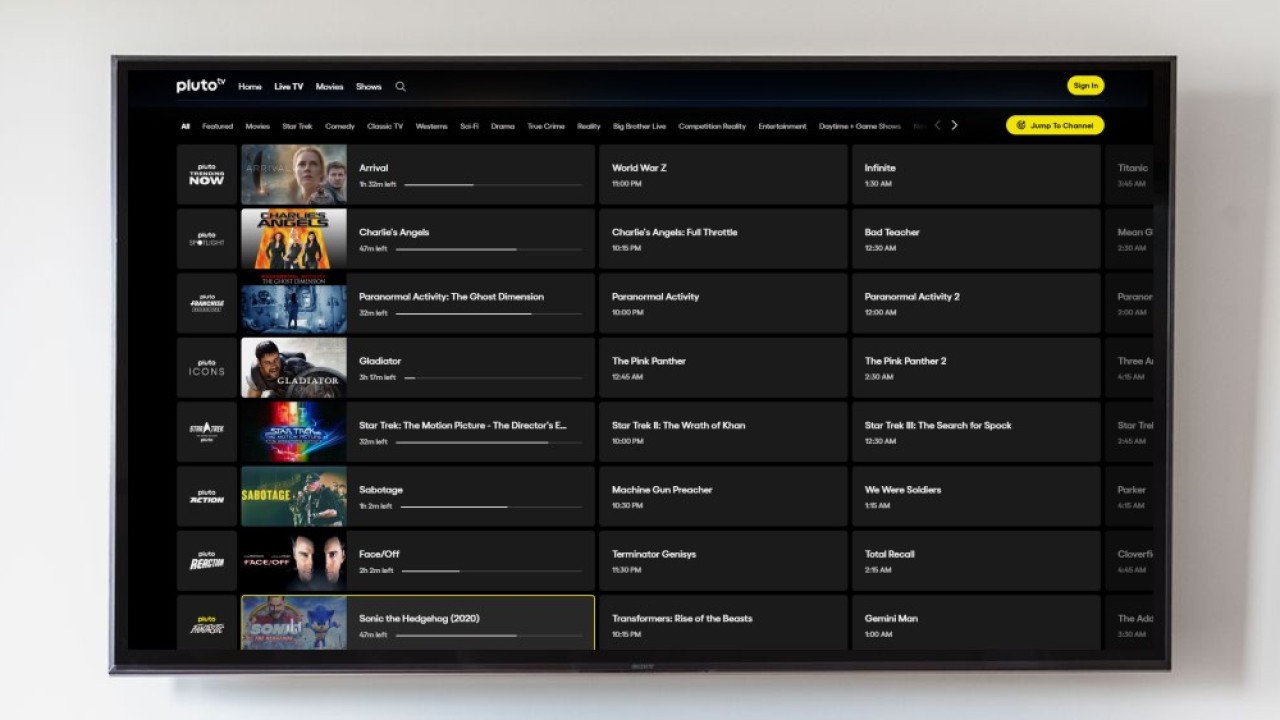
There's an on-demand library as well, with movies and full series you can start from the beginning on your own schedule. But it has always been the smaller half of the service. The live grid is Pluto TV's identity, and it's still where most of the browsing happens. That balance is starting to shift, which we'll come back to.
Pluto TV is owned by Paramount, the same company behind CBS, Nickelodeon, MTV, Comedy Central, and Paramount Pictures. That single fact explains most of what you'll find there. The lineup leans heavily on material from Paramount and its subsidiaries: CBS series like Blue Bloods, NCIS and Ghosts, Nickelodeon cartoons like Rugrats and The Angry Beavers, Paramount films including Transformers and Sonic the Hedgehog, and Comedy Central staples like South Park and Tosh.0.
When a company owns both the platform and the library, filling the schedule costs it almost nothing. There's no licensing negotiation and no revenue to split. It's shelf space stocked from the warehouse next door.
That's why the CBS catalogue runs so deep here, and it is not all archive material. There are dedicated channels for NCIS, Blue Bloods and all three CSI series, current CBS comedy in Ghosts, and movie channels stocked with recent Paramount releases: Sonic the Hedgehog, Transformers: Rise of the Beasts, Gemini Man, Infinite. The deep back catalogue is there as well, running all the way back to I Love Lucy, The Andy Griffith Show and The Beverly Hillbillies.
That range is the real advantage of owning the library. Paramount can fill a schedule with a 2023 blockbuster or a 1951 sitcom and pay nothing extra for either one.
Star Trek gets an entire category to itself, with separate channels for the Original Series, The Next Generation, Deep Space Nine, Voyager and Enterprise. Paramount sitcoms like Cheers and Frasier get the same treatment, and the Nickelodeon and Nick Jr. channels do it with the older cartoon library.
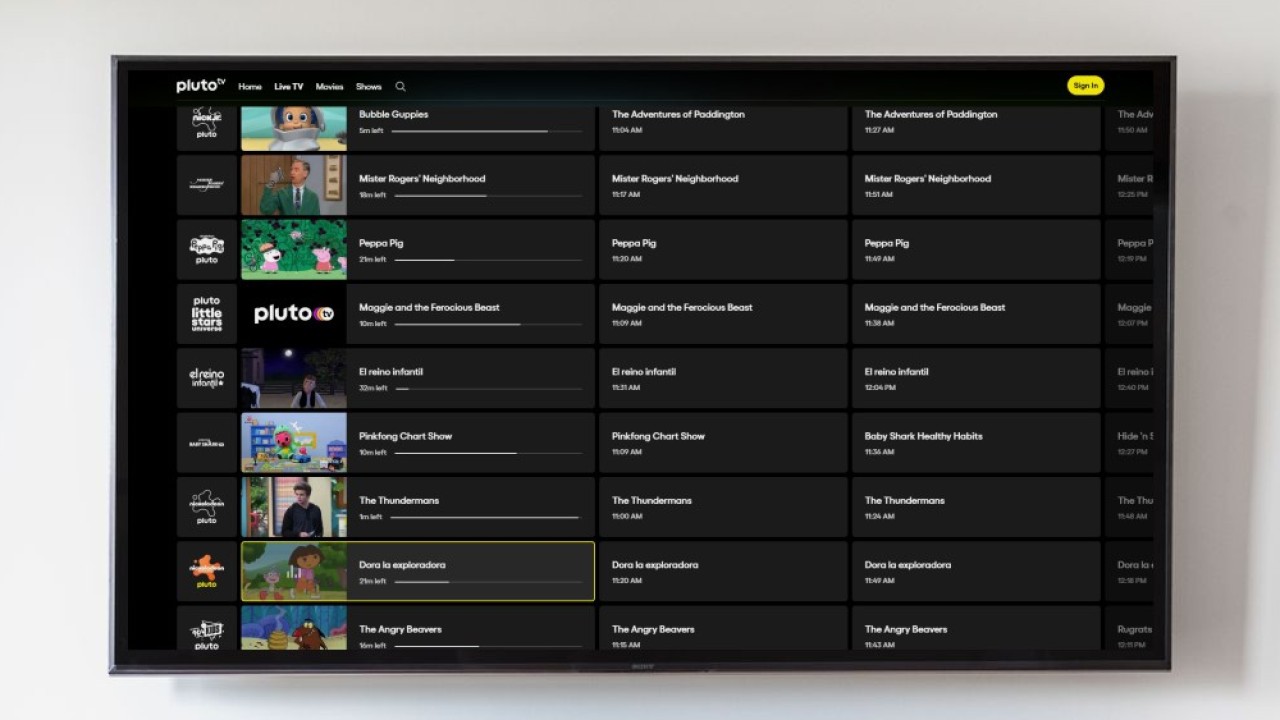
Pluto TV's Kids section makes the point on its own. Nick Jr., Nickelodeon, Peppa Pig, Dora, The Angry Beavers, Rugrats: almost all of it is Paramount's own catalogue, sitting on Paramount's own platform.
Hold onto that idea: own the distribution, fill it with content you already own. It turns out to be the exact same logic running on your antenna.
Browse Pluto TV's classic-TV, game-show and crime-drama sections and you'll run into names that look oddly familiar if you've ever scanned an antenna: Ion, Ion Mystery, MeTV, Antenna TV, Buzzr, Catchy Comedy, Start TV. These are diginets: digital multicast networks that ride along on local stations' subchannels, the 7.2s and 7.3s of the world. They exist over the air first, and plenty of local stations carry them.
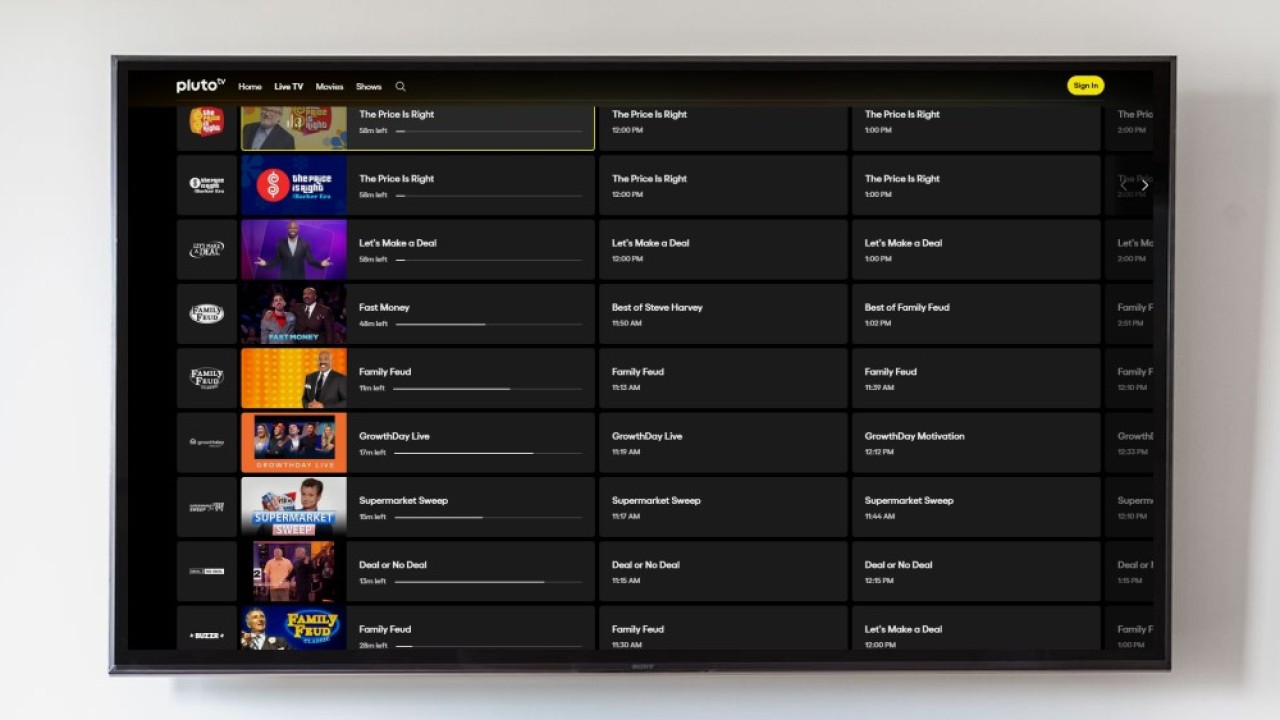
Pluto TV's Daytime + Game Shows section is the clearest example. Alongside single-show channels for The Price Is Right, Let's Make a Deal, Supermarket Sweep and Deal or No Deal, you'll find Buzzr and Game Show Central sitting in the same list. Those two aren't Pluto TV creations. They're diginets, and if you scan an antenna where you live there's a good chance you'll find them again in your local channel lineup, running over the air for free.
A lot of them now stream for free as well, either through their own smart TV apps or as channels on services like Pluto TV, Tubi and The Roku Channel. Ion has its own live channel on Pluto TV, and Scripps, which owns Ion and Ion Mystery along with several other diginets, has put its networks across most of those platforms. So some of what you're flipping past on Pluto TV is programming your antenna may already pull in for you: live, uncompressed, and without an app in the way.
A full-power station's 6 MHz channel carries about 19.39 Mbps, and the main HD feed doesn't use all of it. Leftover bandwidth earns nothing and can't be saved, so stations fill it. The deal is usually barter: the diginet supplies the programming free, and the two split the commercial time. Commonly that's around seven minutes an hour for the network and five for the station, which the station sells to local advertisers using the sales staff it already has.
It's real money but not dramatic money. Diginets typically account for only a few percent of a station's ad revenue. The reason your local lineup is stuffed with them is subtler: many diginets are owned by the same companies that own the local stations. The E.W. Scripps Company is the clearest example. Most viewers know Scripps, if at all, as the name behind their local ABC or NBC affiliate. It owns more than 60 local television stations across 38 markets, and it also owns Ion, Ion Mystery, Bounce, Grit, Laff and Defy TV outright. When one company owns both the transmitters and the networks running on them, there's no split to negotiate at all. It's filling its own airtime with its own programming and keeping all of the ad revenue.
Notice the pattern: Scripps fills subchannels it owns with networks it owns. Paramount fills a streaming platform it owns with a library it owns. That's vertical integration, the same strategy playing out in two different eras of television: when one company controls both the distribution and the content flowing through it, there's no one to split the money with. In both cases, you watch for free because someone else's spare capacity was worth more full than empty.
Paramount takes it a step further than Scripps does, because it owns something to sell you at the end of it. Watch Pluto TV for a while and you'll notice the ad breaks tell the same story as the schedule: a lot of what runs is Paramount advertising Paramount, with trailers for its movies currently in theaters and spots for Paramount+, its paid subscription service. The free product doubles as a marketing channel for the paid one, which is a large part of why Paramount is happy to keep Pluto TV free.
This is where the two stop being interchangeable. Pluto TV has no real local affiliates. It won't give you your market's evening newscast, your local weather coverage when a storm is moving through, or the NFL game your local FOX or CBS station is carrying on Sunday afternoon.
There's a partial exception, and it follows the same ownership logic as everything else here. Pluto TV does have a Local News section, and if you scroll it, you'll notice almost every channel in it is a CBS station. That's not a coincidence. Paramount owns CBS, so those newsrooms are in-house, exactly like Nickelodeon: no licensing deal required, no revenue to split. You'll find CBS-run local streams for Los Angeles, Chicago, Boston, Baltimore, Detroit, Miami, Denver, Minnesota and the Bay Area.
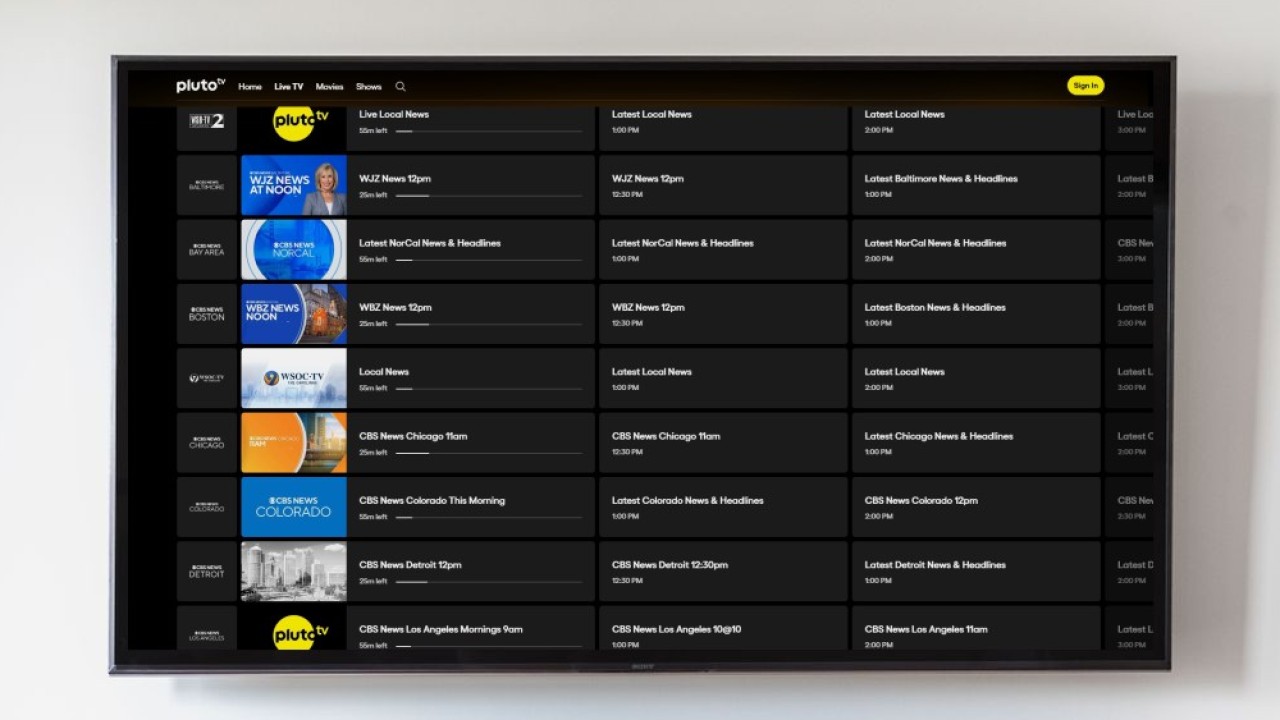
That's genuinely useful if you live in one of those markets. If you don't, there's nothing here that covers your town, and none of it replaces the local news and weather your own stations put out every day.
Which is the catch. Those are the markets where CBS happens to own the station outright, a dozen or so out of more than 200 across the country. If you don't live in one of them, that section has nothing for you, and no amount of free streaming will produce a newscast for your town. Even where it does exist, you're getting a streaming news channel, not the actual broadcast affiliate with its full schedule of network primetime and live sports.
There's also a quieter difference in how the ads work. Broadcast ads go out over one tower to everyone at once. Pluto TV inserts ads server-side, targeted per viewer. That means it can even sell your local market, except that money goes to the platform rather than to a station in your town.
Pluto TV also needs an internet connection. That sounds obvious, but it's the difference that matters most on the day it counts. Pluto TV is streaming, so it depends on your broadband being up and fast enough. An antenna doesn't depend on anything but the tower.
That cuts two ways. A streaming channel is eating bandwidth the whole time it's on, so an afternoon of background TV competes with everyone else in the house who is working, gaming or on a video call. Over-the-air channels use none of it. And when a storm takes the internet down entirely, the channels coming through the air keep working, which matters because those are the ones carrying the emergency coverage.
The practical upshot is that they solve different problems. An antenna is your foundation: local news, local emergencies, network primetime, and live sports, all free and in the full 1080i or 720p HD your station transmits, often less compressed than the same channel on cable or streaming. Pluto TV is a supplement: something on when you want background, or a specific old show you'd never find on a broadcast schedule.
Paramount is consolidating Pluto TV, Paramount+ and BET+ onto a single technical backend, and the rollout is already underway across mobile, web and streaming devices. The most visible change is a redesigned app that moves the old left-hand menu to a top navigation bar and pushes on-demand content forward. Pluto TV's on-demand viewing has grown sharply, and Paramount is leaning into it.
Two things worth knowing if you use it: the services are not merging into one product, and Pluto TV is staying free. They remain separate apps with separate content. The shared plumbing mostly means better recommendations, unified accounts, and an easier path to a paid subscription if you ever want one.
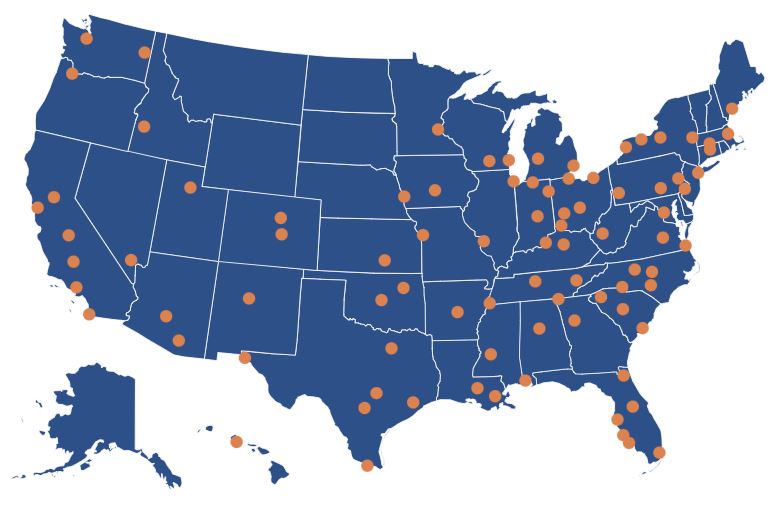
The honest recommendation is to use both. But find out what's free over the air where you live first, because that's the part with your local news and your local games in it. Search your city or zip code to see every station broadcasting in your area, which diginets they carry on their subchannels, and how strong a signal to expect:
If it turns out your area has more free channels than you expected, our guide to choosing the right antenna covers what it takes to actually pull them in. And how one station fits all those channels onto a single signal explains the technology behind those subchannels.
Directory Blog Privacy Policy Contact
This website contains affiliate links. We may receive commissions for purchases made through these links.